When will the LA wildfires be contained?
Chronulus AI can answer the question. But should we?

On Saturday, I sat down with a simple question:
‘Can our Forecasting Agent predict when the LA wildfires will be 100% contained?’
The question is timely and important for the many communities who have been impacted by the fires.
In under an hour, I was a able to produce 28-day containment forecasts for the Palisades and Eaton fires.
While am I comfortable sharing the results from an accuracy perspective, I will not be releasing the forecasts—at least until the fires have been contained.
Let’s discuss how I was able to do this before I address the reasons behind why I am self-censoring the results.
Predicting Wildfire Containment
To forecast the containment levels of the Palisades and Eaton fires, I used the Chronulus prediction platform via our Python SDK.
Our platform is the first to allow users to create forecasts based solely on unstructured data like text and images.
To use an agent, we need to give it a description of the situation, task, and input data.
I’ll walk through what I used for containment prediction.
Situation
Situational information is incredibly important. Since we trained the models behind our agents in late 2024, describing the situation provides our agents with up-to-date contextual information for performing the task over all the inputs we will give the agent for prediction.
To describe the situation in LA, I provided the following background info along with context about the influx of fire fighting resources from a recent press release from the Office of Gov. Newsom:
Wildfires erupted in the Pacific Palisades neighborhood of Westside Los Angeles on January 7, 2025. The wildfires were exacerbated by abnormally strong and persistent Santa Ana winds. As a result, the initial  containment attempts failed and the fires spread to other neighborhoods.

On January 11, a surge of additional resources were announced:

[press release here]
Task
Next, I wrote a task description for our forecasting agent. I planned to use our NormalizedForecaster agent, which excels at providing forecasts that are normalized between 0 and 1 on a range of time scales (hours, days, or weeks).
Thinking ahead, I realized that it would be cleaner to plot the percent of ‘uncontained’ fire as opposed the percent ‘contained’ that is given in press releases and public-facing updates.
To account for this, I simply requested the ‘percent uncontained’ and then gave a short definition ‘1 - the percent contained’. Despite my imprecise language (percentages are expressed on scales of 100 not on scales of 1), our agent interpreted and performed the task as I had intended.
Here’s the task description that I used:
To aid the wildfire response and mitigation, we would like to forecast the percent of uncontained wildfire over time given the resource assumptions we provide. By uncontained wildfire, we mean 1 - the percent contained.Data Model and Inputs for Pacific Palisades and Eaton
With the situation and task described, the only other information our agent needs is a description of the input fields and some input data.
Below, I’ve listed each field, description, and input that I used to forecast the Palisades containment. The inputs used to forecast containment for Eaton are qualitatively the same, with incident name, containment history, and weather updated appropriately.
Incident Name
The incident name. Usually this corresponds to the neighborhood or region that is impacted by the fire.
Palisades Fire
Resource Assumptions
A description of additional results if any that we will add and when.
No additional resources
Containment History
Data points of containment percent for the location.
43% contained on Jan 18
22% contained on Jan 17
17% contained on Jan 16
This info was sourced from the LA County Fire Department twitter account (@LACOFD)
As Of Date
Date of the latest information and assumptions
2025-01-18
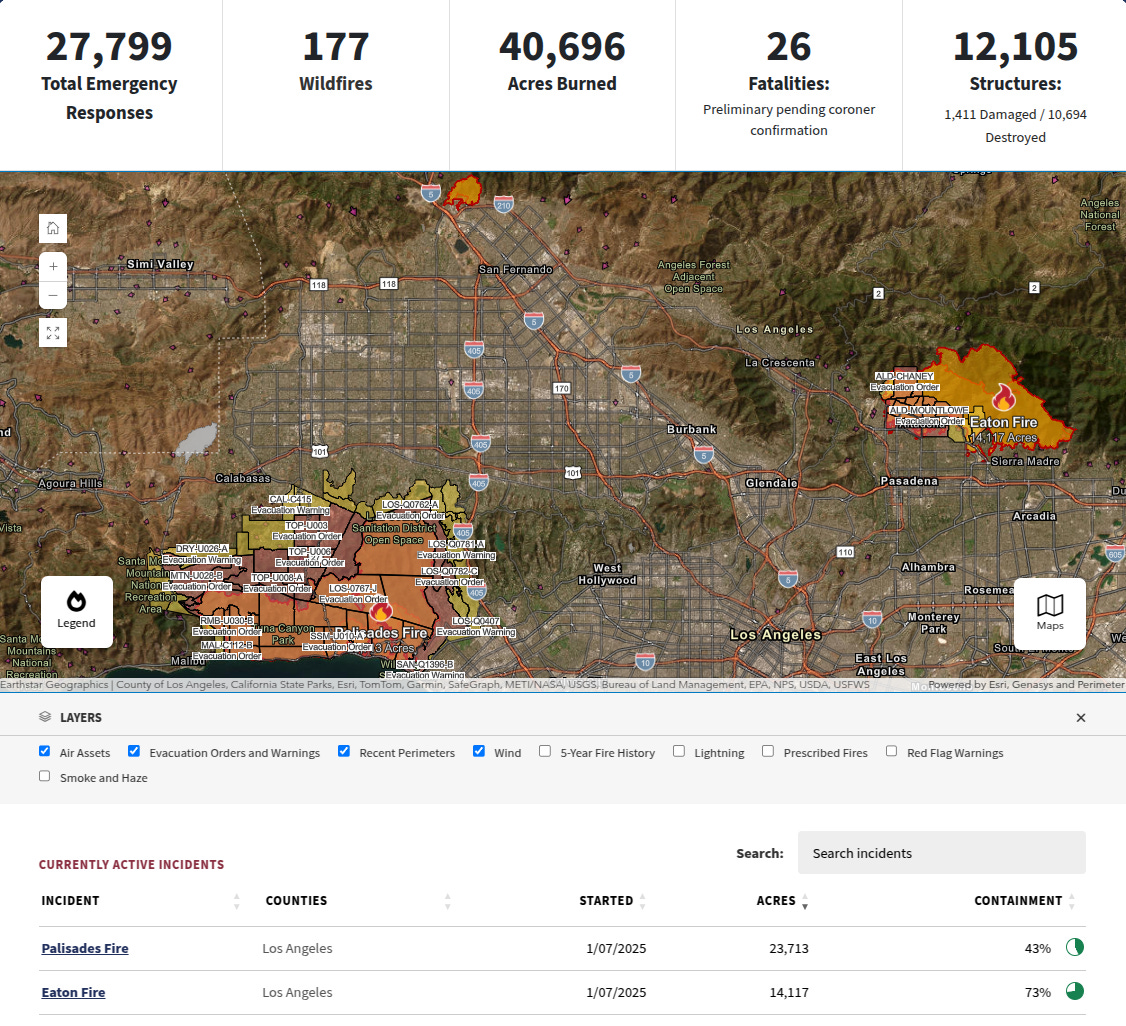
Dashboard Images
Images from the CAL FIRE dashboard with insights into the current state of the incidents and response.
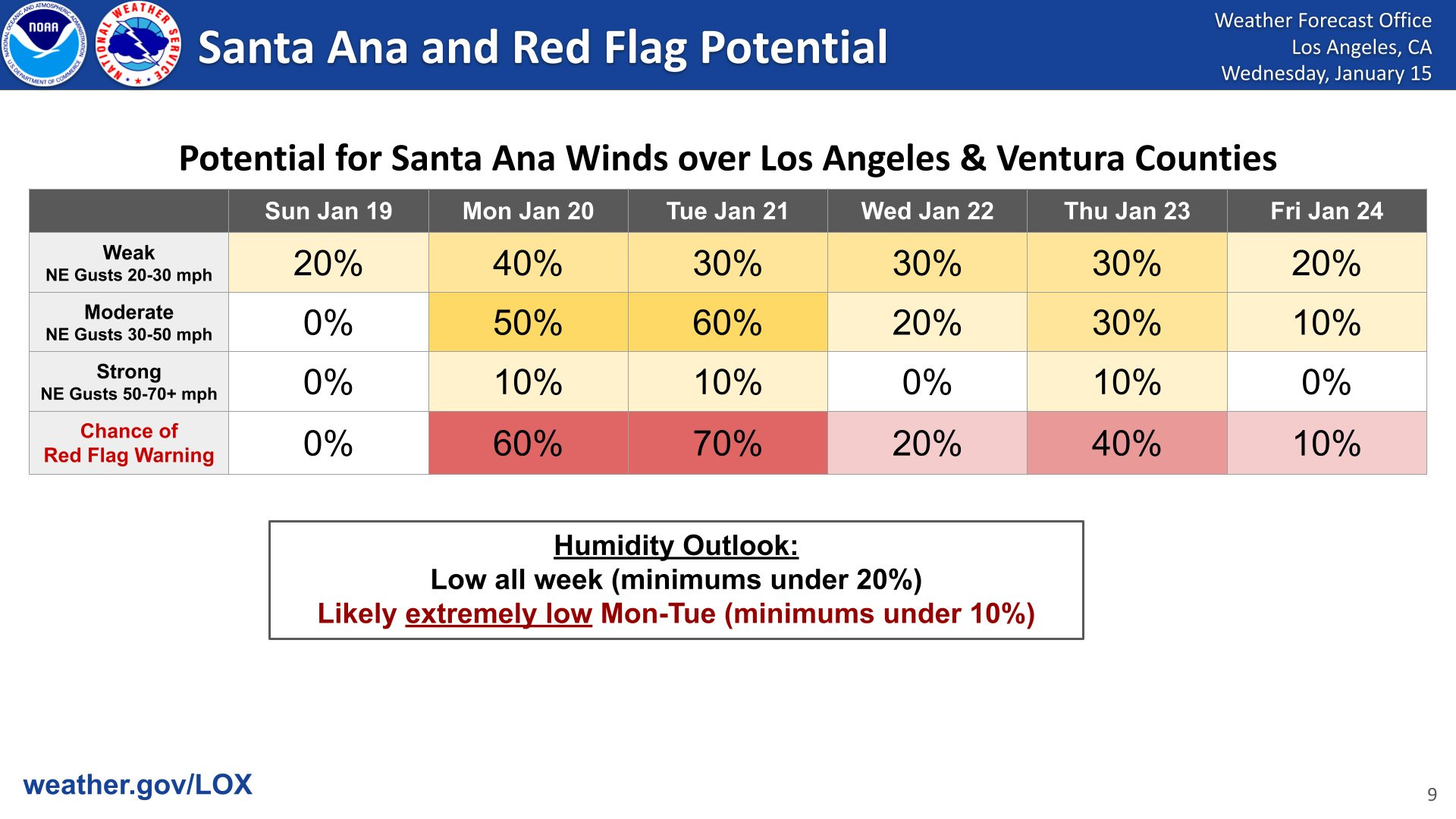
Weather Images
Images of the weather forecast for the location.

Why Not Release Predictions?
As I considered releasing the containment predictions, I asked myself a few questions.
Is this responsible? Who benefits from the release? Who might be harmed? Are the results actionable and useful for containing the fires? Why might official channels not release containment forecasts?
And finally, “Why didn’t our forecasting agent ask these questions??”
Responsible Forecasting Agents
Chronulus AI is a first-mover in the Agentic Forecasting space. We owe it to our customers and the broader forecasting community to not only launch agents that are state-of-the-art in terms of accuracy and performance, but also in their ability to act responsibly.
We are committed to launching agents that help our users weigh and avoid risks.
Collaboration on Wildfire Response
If you work in wildfire or disaster mitigation and response and would like to collaborate, please reach out either on our website or on our LinkedIn page.